
Two Maps, Two Sets of Challenges
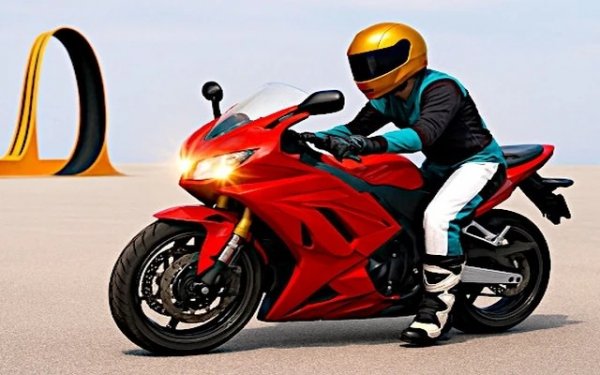
The game includes two separate maps, each with its own arrangement of ramps, turns, and straightaways. The first course establishes the basics, while the second changes the terrain layout to test whether players can adapt their speed and steering. Because the maps differ in structure, finishing one does not guarantee an easy time on the other. Players must learn each route individually, and the restart key lets them retry a level immediately after a fall.
Coins, Bikes, and Skins
Coins are scattered across both maps and serve as the only currency. Collecting enough of them unlocks additional motorcycles from a total of eight. Three bikes begin locked, so there is a clear progression path for anyone who keeps playing. Each motorcycle can also be equipped with different skins. These skins change the look of the bike without altering its performance, so customization remains purely visual and does not create an advantage or disadvantage.
Nitro: Speed and Stability
Nitro boosts provide a temporary increase in speed, but they also help stabilize the motorcycle when navigating winding sections. That dual purpose makes nitro useful in two situations: when a player needs to clear a gap quickly, and when a tricky sequence of turns threatens to send the bike off course. Timing matters. Activating nitro too early or too late can lead to a crash instead of a clean run, so players learn to save boosts for the moments that count.
Local Multiplayer and Controls
Two players can compete on the same device using separate keyboard layouts. Player one steers with the arrow keys, uses N for nitro, and C to adjust the camera. Player two uses W, A, S, and D, with T for nitro and Q for camera control. The R key restarts the current level at any time. The control scheme is designed to be easy to learn, which suits younger players, while the need to balance speed and control gives older players something to master.





Comments
0 comments