
The Two-Turn Rule
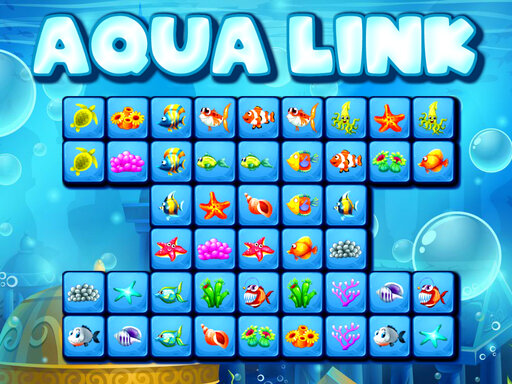
What separates Aqua Link Block Connect from a standard matching game is the path restriction. Two identical blocks can only be cleared if the line connecting them changes direction at most twice. That constraint turns every match into a small spatial problem: you are not just looking for identical symbols, you are checking whether a route exists between them. Blocks near the edges are often easier to pair because the path can run along the border, while clusters in the middle require more careful scanning.
Playing Against the Clock
Each session is governed by a countdown. The goal is to remove every pair before time expires, which shifts the game away from leisurely matching and toward fast decision-making. Successful matches earn points, and the board can become harder to read as the round progresses. Because the timer never pauses, choosing which pair to clear first becomes a real decision: clearing a block that blocks several potential paths can open the board, while chasing an obvious match in a crowded area may leave you stuck later.
Reading the Board
The visual design uses bright, distinct block colors, which helps you separate pairs at a glance. Still, the two-turn rule means speed alone is not enough. Experienced players tend to scan for pairs with open routes before committing, and they prioritize matches that sit near the edges or along clear rows and columns. When no obvious pair is available, shifting attention to less crowded sections of the board often reveals a path that was hidden by surrounding blocks.
Who It Suits
The controls are simple tap or click selections, so the game is approachable for a wide age range. Rounds are short enough for a break but can be played repeatedly for higher scores. Players who enjoy logic puzzles with a time pressure element will get the most out of it, while those looking for a completely untimed experience may find the countdown the main challenge.




Comments
0 comments