
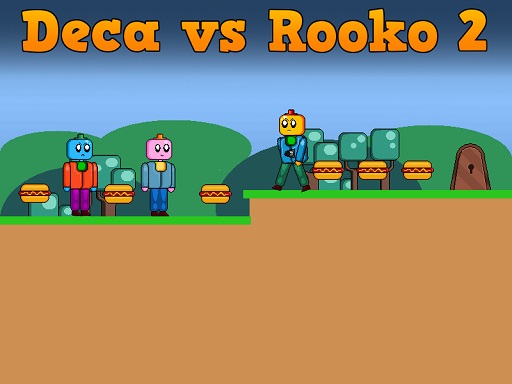
Collect Every Hotdog, Then Escape
Each stage in Deca and Rooko 2 Arcade Journey gives you one clear job: grab all the hotdogs scattered across the layout, then make it to the exit door. The order you collect them matters less than how you time your route. Hazards are fixed or moving, so a path that works on your first attempt may need adjusting after you see how a swinging object or barrier behaves. Touching anything harmful costs a life, which makes observation part of the core loop rather than an optional extra.
Controls and Movement Feel
Deca moves left and right with keyboard arrows or on-screen controls, and jumping is the main tool for survival. The controls are built to feel responsive, so small adjustments mid-jump are possible. That precision matters because obstacles are often placed to punish rushed inputs. You are not fighting the character; you are reading the level and committing to a jump at the right moment.
Hazards, Patterns, and Rising Difficulty
Spikes, moving barriers, and swinging objects form the basic hazard set. Later levels introduce faster versions and more complex arrangements, which shifts the challenge from simple reaction to pattern recognition. Enemies follow set routes, so watching them for a few seconds before moving is a genuine strategy. The difficulty curve is steady: each new stage adds a wrinkle rather than a wall.
Who This Is For
The bright, colorful art style and lack of violent content make this a comfortable pick for children and casual players, but the timing demands will still test platformer fans who want a light arcade challenge. There is no penalty for replaying earlier levels, and doing so is a practical way to sharpen reflexes before tackling faster hazards. If you enjoy collect-a-thon platformers with a cheerful tone, this sequel fits that mold.







Comments
0 comments